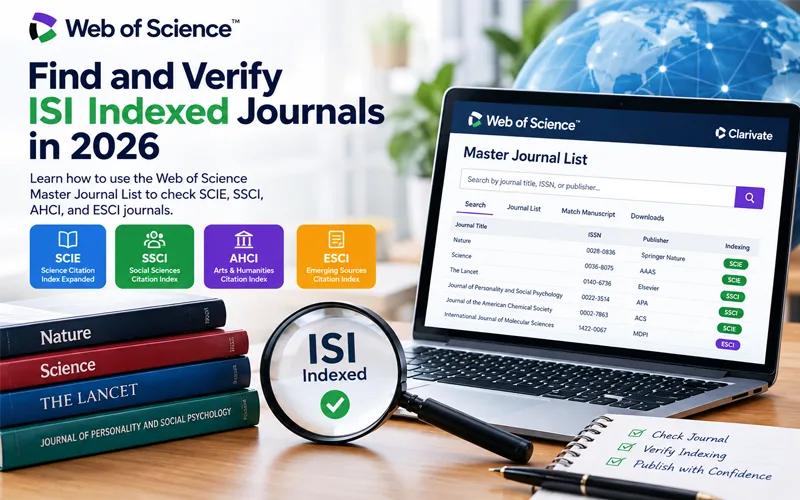
ISI Indexed Journals List 2026: How to Find and Verify Web of Science Journals
Researchers frequently search for an ISI indexed journals list when selecting a journal for a research paper, thesis-derived article, systematic review, or academic promotion requirement.
The problem is that thousands of unofficial “ISI journal lists” are available online. Some are outdated, some combine different indexing databases, and others contain journals that are no longer covered by Web of Science.
In 2026, the safest approach is not to download an old spreadsheet or rely on a third-party website.
Researchers should verify each journal through the Web of Science Master Journal List, the official journal-search resource provided by Clarivate.
This guide explains how to find genuine Web of Science indexed journals, how to identify whether a journal belongs to SCIE, SSCI, AHCI, or ESCI, how to avoid outdated journal lists, and how to verify a journal before submitting your manuscript.
What Does “ISI Indexed Journal” Mean?
The term ISI indexed journal is still widely used by researchers, universities, academic institutions, and publication services.
Historically, ISI refers to the Institute for Scientific Information, founded by Eugene Garfield, which developed influential citation indexes used for scholarly research evaluation.
Today, the relevant citation infrastructure is part of Web of Science, operated by Clarivate.
Therefore, when researchers search for an:
- ISI indexed journals list
- ISI journal list
- ISI journal search
- ISI journals 2026
- ISI journal verification
they are usually looking for journals indexed in the Web of Science Core Collection.
The four journal indexes that researchers most frequently encounter are:
- Science Citation Index Expanded (SCIE)
- Social Sciences Citation Index (SSCI)
- Arts & Humanities Citation Index (AHCI)
- Emerging Sources Citation Index (ESCI)
Web of Science Core Collection currently indexes more than 22,000 journals across science, social sciences, arts, and humanities.
Where Can You Find the Official ISI Indexed Journals List?
The official source is the:
Web of Science Master Journal List
The Master Journal List, commonly called MJL, is maintained by Clarivate.
It should be the first place researchers check when they want to know whether a journal is currently covered by Web of Science.
Researchers can use the Master Journal List to:
- Search for a journal by title
- Search by ISSN or eISSN
- Identify the Web of Science collection
- Check subject categories
- Review coverage information
- Explore journal title lists
- Follow changes in Web of Science journal coverage
Clarivate specifically directs researchers to the freely available Master Journal List to check which journals are covered and to review changes in coverage.
This is significantly more reliable than using an old PDF, Excel file, social-media post, or commercial website claiming to provide a “complete ISI list.”
Why You Should Not Trust a Downloaded ISI Journal List Without Verification
A static journal list can become outdated quickly.
Journal indexing is not necessarily permanent.
Clarivate describes Web of Science as a dynamic collection in which journals are periodically re-evaluated.
A journal may:
- enter ESCI;
- move from ESCI to SCIE, SSCI, or AHCI;
- move from a flagship index back to ESCI;
- lose coverage if it no longer meets quality criteria.
Clarivate states that journals are continuously evaluated and that journals failing the required quality criteria can be removed from the Web of Science Core Collection.
Therefore:
A journal that was indexed in 2023, 2024, or 2025 should not automatically be assumed to remain indexed in 2026.
Always verify the journal again before submission.
How to Check Whether a Journal Is ISI Indexed in 2026
The process is straightforward but should be done carefully.
Step 1: Find the Exact Journal Title
Start with the complete official journal title.
Do not rely solely on abbreviations.
For example, several journals may have similar titles containing words such as:
- International Journal of...
- Journal of Advanced...
- European Journal of...
- Asian Journal of...
- International Review of...
This can create confusion.
Step 2: Find the ISSN or eISSN
The ISSN is one of the most useful identifiers for journal verification.
A journal may have:
- Print ISSN
- Electronic ISSN
- Both
Searching by ISSN reduces the risk of confusing two journals with similar names.
When possible, obtain the ISSN from:
- the journal's official website;
- the publisher's website;
- the article PDF;
- a recognized bibliographic source.
Then verify that identifier independently in the Master Journal List.
Step 3: Search the Web of Science Master Journal List
Search using:
Journal title
or preferably:
ISSN / eISSN
If the journal appears, examine the record carefully.
Do not stop after simply seeing the title.
Step 4: Check the Web of Science Index
Determine whether the journal is indexed in:
SCIE
Science Citation Index Expanded
Typically relevant to fields such as:
- Medicine
- Engineering
- Biology
- Chemistry
- Physics
- Computer science
- Environmental science
- Agriculture
- Materials science
Clarivate currently reports more than 9,000 actively publishing journals in SCIE across a large number of subject categories.
SSCI
Social Sciences Citation Index
Relevant to disciplines such as:
- Economics
- Management
- Psychology
- Sociology
- Education
- Political science
- Communication
- Public administration
- Urban studies
AHCI
Arts & Humanities Citation Index
Relevant to:
- Literature
- History
- Philosophy
- Linguistics
- Art
- Cultural studies
- Film
- Religion
- Humanities
ESCI
Emerging Sources Citation Index
ESCI contains journals that have passed Web of Science quality evaluation.
Clarivate explains that journals meeting its 24 quality criteria are admitted to ESCI, while journals meeting four additional impact criteria may enter SCIE, SSCI, or AHCI according to discipline.
SCIE vs SSCI vs AHCI vs ESCI: Which One Should You Choose?
There is no single index that is best for every researcher.
The correct index depends primarily on your discipline and institutional requirements.
| Index | Main Area | Typical Fields |
| SCIE | Science and technology | Medicine, engineering, biology, chemistry |
| SSCI | Social sciences | Management, economics, psychology, education |
| AHCI | Arts and humanities | Literature, history, philosophy, arts |
| ESCI | Emerging and developing journals across disciplines | Multidisciplinary |
You should first determine what your university, funding organization, or academic promotion system requires.
For example, an institution may specifically require:
- SCIE only;
- SCIE or SSCI;
- any Web of Science Core Collection journal;
- Q1 or Q2 journals;
- journals with a Journal Impact Factor.
These are not equivalent requirements.
Is ESCI Really ISI Indexed?
Yes, ESCI is part of the Web of Science Core Collection.
This distinction matters because some websites incorrectly describe ESCI journals as “not ISI.”
That description is misleading.
ESCI journals have passed Web of Science quality evaluation, but their position within Clarivate's journal-selection framework differs from journals in SCIE, SSCI, and AHCI.
Clarivate explicitly states that selected journals meeting its quality criteria enter ESCI, while journals meeting additional impact criteria may be included in one of the flagship indexes.
However, whether an ESCI publication satisfies a specific university regulation is a different question.
Researchers should therefore distinguish between:
Web of Science indexing
and
institutional eligibility requirements.
Does Every ISI Indexed Journal Have an Impact Factor?
Researchers often assume:
ISI indexed = Impact Factor journal.
This is an oversimplification.
The Journal Impact Factor (JIF) is a metric published through Clarivate's Journal Citation Reports (JCR).
Clarivate explains that journals accepted into Web of Science Core Collection before the relevant annual cutoff and remaining covered during JCR production can become eligible for journal-level metrics, including JIF and JCI.
Therefore, researchers should check:
- Web of Science indexing;
- JCR status;
- Journal Impact Factor;
- quartile;
as related but distinct pieces of information.
How to Check a Journal's Impact Factor
Once you verify Web of Science indexing, you may also want to check its current Journal Impact Factor.
The most authoritative source is:
Journal Citation Reports — JCR
Do not rely on a journal's own website alone.
Unscrupulous or low-quality journals sometimes display metrics with names such as:
- Global Impact Factor
- Universal Impact Factor
- International Impact Factor
- Scientific Impact Factor
- Academic Impact Factor
These are not automatically equivalent to the official Journal Impact Factor issued through Clarivate.
When a university specifically asks for “Impact Factor,” verify which metric it recognizes.
How to Check Whether an ISI Journal Is Q1, Q2, Q3, or Q4
After confirming the journal's indexing status, researchers frequently want to determine its quartile.
The four quartiles are generally interpreted as:
- Q1: highest 25%
- Q2: 25–50%
- Q3: 50–75%
- Q4: lowest 25% within the relevant ranked group
However, journal quartiles must be interpreted carefully.
A journal can belong to multiple subject categories.
For example, the same journal may be:
- Q1 in one category;
- Q2 in another.
You should therefore always report:
- Database
- Year
- Category
- Quartile
rather than simply saying:
“This is a Q1 journal.”
Web of Science Quartile vs Scopus Quartile
This distinction is extremely important.
A journal's JCR quartile and Scopus-based quartile are not necessarily the same.
For example, a journal may be:
JCR Q2
but:
Scopus Q1
This is not an error.
The databases use different:
- datasets;
- categories;
- citation metrics;
- ranking methodologies.
Therefore, before submitting a manuscript, determine whether your institution requires:
- JCR quartile;
- Scopus quartile;
- SJR quartile;
- CiteScore percentile;
- another metric.
Do not use these interchangeably.
Can a Journal Be Indexed in Both Web of Science and Scopus?
Yes.
Many journals are indexed in both databases.
Four common situations are possible:
1. Web of Science + Scopus
The journal is covered in both.
2. Web of Science only
The journal is covered by Web of Science but not currently by Scopus.
3. Scopus only
The journal is covered by Scopus but not by Web of Science.
4. Neither
The journal is not covered in either database.
If your target requirement is specifically an ISI/Web of Science journal, Scopus indexing alone is insufficient.
How Often Does the ISI Indexed Journals List Change?
There is no single permanent “ISI journal list.”
The collection changes as journals are:
- evaluated;
- added;
- reclassified;
- discontinued;
- removed.
Clarivate explicitly describes Web of Science as a dynamic collection subject to periodic re-evaluation.
Researchers should therefore verify indexing status at several stages:
Before choosing the journal
Confirm that it currently meets your requirements.
Before submission
Check again if a significant amount of time has passed.
Before paying publication fees
Verify that no important indexing change has occurred.
Before using the paper for institutional purposes
If your university evaluates the indexing status at publication date or assessment date, check the relevant regulation.
What Does “Discontinued from Web of Science” Mean?
A journal may previously have been indexed but later lose coverage.
Possible reasons can involve failure to continue meeting Web of Science standards.
Clarivate's journal evaluation framework includes quality factors such as:
- peer-review policy;
- editorial information;
- publication ethics;
- journal content;
- author information;
- publication regularity;
- citation behavior.
The journal-selection process uses 28 criteria: 24 quality criteria and four impact criteria.
If a journal fails the required quality standards during re-evaluation, it may be removed from the Core Collection.
How Do Journals Enter the Web of Science?
Journals do not become Web of Science indexed simply by applying.
Clarivate evaluates candidate journals.
The process includes assessment of editorial standards, publication practices, scholarly content, peer review, ethics, and other quality characteristics.
Clarivate states that its journal evaluation system uses:
- 24 quality criteria
- 4 impact criteria
New journal submissions are initially evaluated for quality, and journals accepted at that level enter ESCI.
After editorial evaluation, selected journals also undergo technical onboarding before their content is indexed.
How Can You Tell Whether a Journal Website Is Making a False Indexing Claim?
Do not treat any of these statements as proof:
“ISI listed”
“ISI approved”
“Submitted to Web of Science”
“Under Clarivate evaluation”
“Thomson indexed”
“Internationally indexed”
“ISI candidate”
“Expected to receive Impact Factor soon”
Only current coverage in the official Web of Science resources confirms present indexing.
A journal can apply for evaluation without being accepted.
A journal can also claim that it is “under evaluation,” but this does not guarantee future inclusion.
Beware of Hijacked Journals
A particularly serious threat is the hijacked journal.
A hijacked journal is a fraudulent website impersonating a legitimate academic journal.
Researchers may search for the legitimate journal name and unknowingly submit their manuscript to a fake website.
To reduce this risk:
- Check the exact journal title.
- Verify the ISSN.
- Verify the publisher.
- Check the official journal URL.
- Compare editorial information.
- Follow links from trusted indexing or publisher sources where possible.
- Be suspicious of guaranteed acceptance.
Clarivate notes that its journal-selection process is intended, among other functions, to guard against hijacked and predatory titles entering its collections.
A Practical ISI Journal Verification Checklist
Before submitting a paper, use the following checklist.
Indexing Verification
- Is the journal listed in the Master Journal List?
- Does the journal title match exactly?
- Does the ISSN match?
- Does the publisher match?
- Which Web of Science index covers it?
Ranking Verification
- Does it have a current JIF?
- What is the JCR year?
- What is the journal category?
- What is the JCR quartile?
- Does your institution require a specific quartile?
Scope Verification
- Does the journal publish papers on your topic?
- Has it published similar papers recently?
- Does it accept your article type?
- Does your methodology fit its recent publications?
Publisher Verification
- Is the publisher identifiable?
- Is the editorial board credible?
- Are publication ethics policies available?
- Is peer review clearly described?
Financial Verification
- Is the journal fully open access, hybrid, or subscription-based?
- Is an APC required?
- Is the fee stated transparently?
- Are waivers available?
Submission Verification
- Are author guidelines clear?
- Is the submission system legitimate?
- Does the journal promise guaranteed acceptance?
- Are publication timelines realistic?
If any of these points are unclear, investigate further before submitting.
How to Build a Shortlist from the ISI Indexed Journals List
Finding thousands of Web of Science journals is easy.
Finding the right five journals for one manuscript is much harder.
A useful shortlist should consider multiple factors.
1. Subject Fit
Start with journals directly related to the paper's main research question.
2. Recent Article Similarity
Search each journal for papers published during the last two or three years.
Look for similarities in:
- topic;
- population;
- methodology;
- theoretical framework;
- data type.
3. Journal Quartile
Decide whether your priority is:
- Q1;
- Q2;
- Q3;
- Q4;
- any Web of Science indexed journal.
Higher quartile does not automatically mean higher manuscript suitability.
4. Methodological Expectations
A manuscript based on:
- a small local survey;
- a large national database;
- a randomized controlled trial;
- machine learning;
- qualitative interviews;
- meta-analysis;
will face very different editorial expectations.
5. Geographic Relevance
Some journals prioritize:
- global research;
- developing countries;
- specific geographical regions;
- local policy implications.
This can materially influence editorial fit.
6. Publication Model
Determine whether you prefer:
- subscription;
- hybrid;
- open access.
Also verify whether the APC is affordable.
7. Acceptance Realism
A manuscript may technically fit a top journal but still have a very low realistic acceptance probability.
A good journal-selection strategy balances:
prestige + scope fit + methodological strength + novelty + realistic acceptance probability
rather than maximizing Impact Factor alone.
Example: How to Verify a Journal Properly
Suppose you identify a journal that appears suitable.
Do not simply search Google for:
“Journal Name ISI”
Instead:
Check 1
Find the exact journal title and ISSN.
Check 2
Search the Web of Science Master Journal List.
Check 3
Confirm SCIE, SSCI, AHCI, or ESCI coverage.
Check 4
If ranking matters, check the current JCR information.
Check 5
Review the journal's official aims and scope.
Check 6
Open several recent articles.
Check 7
Review author guidelines.
Check 8
Check fees and publication model.
Only after these steps should the journal move onto your final submission shortlist.
Common Mistakes When Searching for ISI Indexed Journals
Mistake 1: Using Old Excel Lists
Journal status changes.
An old downloaded list can produce incorrect decisions.
Mistake 2: Trusting the Journal Website Alone
A journal may display incomplete, outdated, or misleading indexing information.
Always verify independently.
Mistake 3: Confusing Scopus with Web of Science
Scopus indexing does not automatically mean Web of Science indexing.
Mistake 4: Confusing Q1 with ISI
Q1 is a ranking position.
ISI/Web of Science refers to indexing.
They are not synonymous.
Mistake 5: Confusing ESCI with “Not Indexed”
ESCI is part of the Web of Science Core Collection.
Mistake 6: Looking Only at Impact Factor
A journal with a high Impact Factor but poor scope fit may reject the paper immediately.
Mistake 7: Ignoring the Subject Category
Quartiles depend on category.
A journal can have different rankings in different categories.
Mistake 8: Paying Before Verification
Do not pay publication charges simply because a journal claims ISI status.
Verify its identity and indexing first.
Is There a Complete ISI Journals PDF for 2026?
Researchers frequently search for:
- ISI journals list 2026 PDF
- ISI journal list Excel
- SCIE journals list PDF
- SSCI journal list 2026
- Web of Science journals Excel
Static lists can be useful for preliminary screening, but they should not be considered definitive evidence of current indexing.
The journal's current record in official Clarivate resources should remain the final verification point.
Clarivate also makes title lists and coverage-change information available through its Web of Science journal resources.
Can TADBIRSAZ Help You Find a Suitable ISI Journal?
Selecting an indexed journal involves more than finding a title in a database.
A realistic journal assessment should evaluate:
- Web of Science indexing
- SCIE/SSCI/AHCI/ESCI status
- Subject scope
- Journal quartile
- Journal Impact Factor
- Manuscript type
- Methodology
- Novelty
- Sample size
- Geographic relevance
- Recent publications
- Publication fees
- Author guidelines
- Expected editorial selectivity
TADBIRSAZ can assist researchers with:
- Web of Science journal verification
- Journal shortlist preparation
- Manuscript–journal fit assessment
- Academic manuscript editing
- Journal formatting
- Cover letter preparation
- Submission preparation
- Reviewer-response revision
Journal acceptance can never ethically be guaranteed because the final decision belongs to journal editors and peer reviewers.
Professional support should instead improve the quality, fit, compliance, and presentation of the manuscript.
Frequently Asked Questions About the ISI Indexed Journals List
Where can I find the official ISI indexed journals list?
Use the Web of Science Master Journal List maintained by Clarivate.
How do I know if a journal is really ISI indexed?
Search the journal by exact title or ISSN and confirm its coverage in the Web of Science Core Collection.
Is ESCI an ISI index?
ESCI is part of the Web of Science Core Collection.
Are all SCIE journals Impact Factor journals?
Indexing status and JIF should be verified separately through the relevant Clarivate resources.
Can an ISI journal lose its indexing?
Yes. Web of Science journals are subject to ongoing evaluation and may be reclassified or removed.
How often should I verify a journal?
At minimum, verify it before submission. For long review processes or important institutional requirements, check again before publication or formal evaluation.
Should I search by journal title or ISSN?
ISSN is generally safer because journal titles may be similar.
Is a Q1 Scopus journal automatically Q1 in Web of Science?
No. Scopus and JCR quartiles are calculated separately.
Is a Scopus journal automatically an ISI journal?
No. The two databases have independent journal coverage.
Can a journal be both SCIE and Scopus indexed?
Yes. Many major journals are covered by both.
Is the journal's own website enough to verify indexing?
No. Use an independent official indexing source.
Is a journal “under evaluation by Web of Science” already indexed?
No. Evaluation does not equal acceptance.
Final Checklist: Verify Before You Submit
Before submitting your manuscript to any journal advertised as an ISI journal, confirm the following:
- Exact journal title
- ISSN/eISSN
- Publisher
- Web of Science coverage
- SCIE/SSCI/AHCI/ESCI status
- Current JCR information if required
- Quartile and subject category
- Aims and scope
- Recent related articles
- Article type compatibility
- Publication fee
- Peer-review policy
- Research ethics requirements
- Submission guidelines
The central rule is simple:
Never submit to a journal solely because its website or an unofficial list says it is ISI indexed. Verify the journal independently through Clarivate before submission.
Conclusion
Searching for an ISI indexed journals list in 2026 should be the beginning of journal selection, not the end.
The Web of Science Core Collection contains thousands of journals across SCIE, SSCI, AHCI, and ESCI, and journal coverage changes over time.
For this reason, researchers should avoid treating any static PDF or Excel file as permanently valid.
The best workflow is:
Identify the journal → verify its ISSN → check the Master Journal List → confirm the Web of Science index → check JCR and quartile if relevant → assess scope → examine recent articles → verify fees and guidelines → submit.
This approach reduces the risk of submitting to:
- an unsuitable journal;
- an outdated journal;
- a discontinued journal;
- a fake or hijacked journal;
- a journal whose indexing does not satisfy institutional requirements.
More importantly, it changes journal selection from a simple search for “ISI journals” into an evidence-based publication strategy.
Need Help Finding the Right Web of Science Journal?
If you have a completed manuscript and are unsure which SCIE, SSCI, AHCI, or ESCI journal is most appropriate, TADBIRSAZ can assist with journal verification, manuscript–journal matching, academic editing, formatting, and revision support.
Explore our ISI / Web of Science Journal Publication Services for professional support with journal selection and manuscript preparation.